
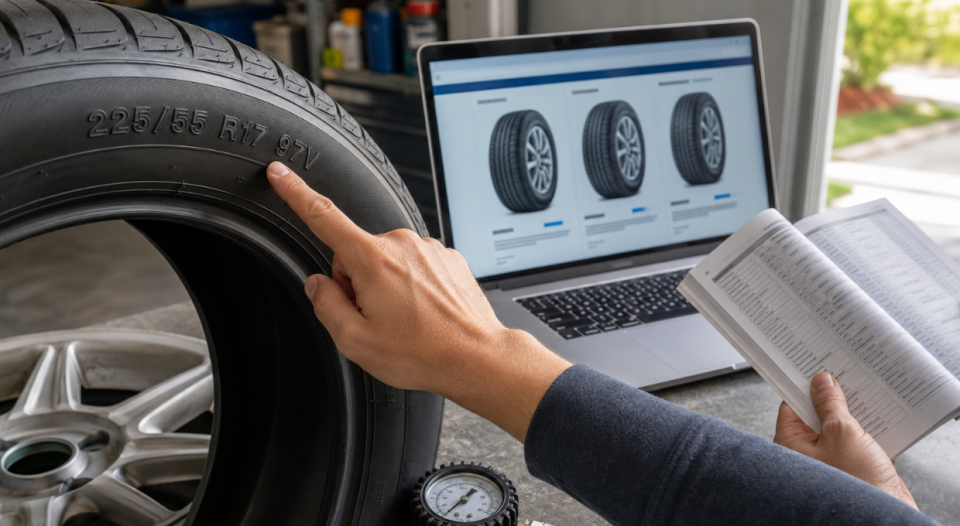
Buying tires online gives you access to many sizes, tread patterns, and price ranges. The difficult part is making sure the tires fit your vehicle and support its weight and performance requirements.
A tire listing might show a code such as 225/55 R17 97V. Every part of this code has a specific meaning. Learning how to read it helps you avoid ordering tires that are too narrow, too short, too weak, or designed for the wrong wheel.
Where Should You Find the Correct Tire Size?
Start with the tire information placard inside the driver’s door or door frame. It normally lists the original tire size and recommended cold inflation pressure.
The owner’s manual might also provide approved sizes. Check these sources before copying the numbers from the tires currently installed. A previous owner might have changed the wheels or installed a different size.
If the vehicle has different front and rear tire sizes, record both. This staggered setup is common on some sports cars and performance vehicles.
What Does 225 Mean?
In the size 225/55 R17, the first number is the tire’s section width in millimeters. A 225 tire is approximately 225 millimeters wide at its widest point when mounted on an approved wheel.
A wider tire does not automatically mean better performance. It must match the wheel width and fit inside the wheel well without rubbing the suspension, fender, or other components.
Changing width also affects steering feel, rolling resistance, and clearance.
What Does 55 Mean?
The second number is the aspect ratio. It describes the sidewall height as a percentage of the tire’s width.
For a 225/55 tire, the sidewall height is 55 percent of 225 millimeters. It is not a direct measurement in millimeters.
A lower aspect ratio usually creates a shorter, stiffer sidewall. A higher ratio provides a taller sidewall and often more cushioning over bumps.
Changing the aspect ratio alters the tire’s overall diameter. This might affect speedometer readings, ride quality, gearing, and clearance.
What Do R and 17 Mean?
The letter R means radial construction. Most modern passenger tires use this design.
The number 17 is the wheel diameter in inches. A 17-inch tire fits a 17-inch wheel. It will not fit a 16-inch or 18-inch wheel, even when the other numbers appear similar.
Wheel diameter is different from the tire’s total outside diameter. The complete size code determines the overall height.
What Is the Load Index?
In 225/55 R17 97V, the number 97 is the load index. It represents the maximum weight one properly inflated tire is designed to carry.
A load index of 97 corresponds to approximately 1,609 pounds, or 730 kilograms, per tire. The value comes from a standardized load index chart.
Never choose a replacement tire with a lower load index than the vehicle requires. SUVs, trucks, electric vehicles, and vehicles used for hauling often need higher load capacity.
Some tires also carry XL, meaning extra load. Light-truck tires might use markings such as LT, Load Range E, or another load-range designation. These tires follow different load and pressure requirements from standard passenger tires.
What Is the Speed Rating?
The final letter is the speed rating. In this example, V represents a tested maximum speed capability of 149 mph, or 240 km/h, under specified conditions.
The rating does not recommend driving at that speed. It describes the tire’s ability to manage heat and stress in controlled testing.
Common ratings include:
- S: 112 mph
- T: 118 mph
- H: 130 mph
- V: 149 mph
- W: 168 mph
- Y: 186 mph
Choose a speed rating that meets or exceeds the vehicle manufacturer’s requirement. Installing a lower rating might affect handling, heat resistance, and vehicle performance.
What Other Markings Should You Check?
Look for all-season, summer, winter, or all-terrain designations. Tires with the same size and service description might serve completely different driving conditions.
Also check whether the tire is directional or has an inside and outside mounting position. Run-flat tires and self-sealing tires require additional consideration.
The four-digit date code shows the week and year of manufacture. For example, 2425 means the tire was produced during the 24th week of 2025.
What Should You Confirm Before Ordering?
Before completing an online purchase, confirm:
- Front and rear tire sizes
- Wheel diameter
- Required load index
- Required speed rating
- Passenger or light-truck classification
- Seasonal tire type
- Quantity needed
- Installation availability
Do not use the maximum pressure printed on the tire sidewall as the normal inflation target. Follow the vehicle placard for recommended cold tire pressure.
Reading the entire tire code takes only a few minutes. That quick check helps ensure the tires fit correctly, carry the required load, and match the vehicle’s intended performance.
This post was written by a professional at Tires2Go Florida. Tires2Go Florida is a trusted automotive service center located in Pinellas Park, Florida, serving drivers across St. Petersburg, Tampa, Clearwater, and Largo. Our certified mechanics handle tire and wheel replacement, brake service, suspension repairs, oil change Pinellas Park FL, wheel alignments, tire balancing, and road force balancing. We also specialize in ADAS calibration, suspension modifications, lift kits, and lowering kits using quality parts and modern diagnostic equipment. From routine maintenance to advanced automotive services, Tires2Go Florida provides dependable solutions and tires for sale for vehicles throughout the Tampa Bay area.
