
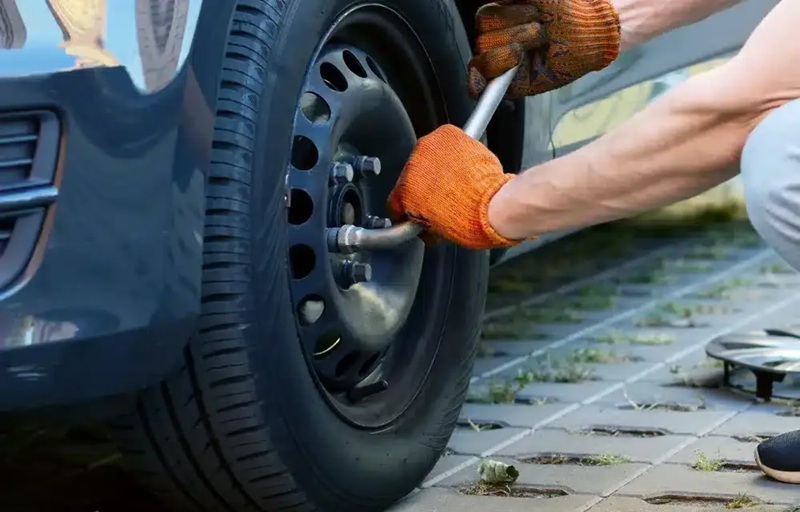
A flat tyre presents three possible responses, fix it where it sits, drive somewhere on a temporary measure, or have the vehicle recovered. Choosing wrongly costs either money or safety. Drivers who limp to a workshop on a deflating tyre often arrive needing a new one instead of a repair, while drivers who call for recovery over a simple nail puncture pay for a tow they never needed. The judgement is not complicated once you know what to look at.
Assess the Damage Before Calling Anything
Start with location. Damage in the central tread band, where the tyre is thickest and least flexible, is generally repairable. Damage on the sidewall or the shoulder is not, because those areas flex with every rotation and no repair survives that movement reliably. Then look at size a puncture from a nail or screw is usually within limits, while a gash or a hole you could fit a finger into is not. Finally check for bulges, which indicate the internal structure has separated and the tyre is at risk of sudden failure regardless of pressure.
Situations That Suit Roadside Repair
Several common scenarios are ideal candidates. A nail or screw picked up in the tread, causing a slow deflation over hours or days, is the textbook case. A tyre found flat in a car park or driveway with no obvious external damage is another, since it can be inspected and repaired without moving the vehicle at all. A valve stem leak is quick to resolve on site. So is a wheel that has simply lost pressure through a poor bead seal. In each of these the vehicle is stationary and safe, the damage is contained, and calling for mobile tyre repair in Singapore resolves it faster and cheaper than any alternative.
When Recovery Is the Better Call
Some circumstances rule out roadside work regardless of the tyre. A vehicle stopped in a live traffic lane, on a blind bend, or in a position where a technician cannot work safely needs to be moved first. Damage extending beyond the tyre a bent rim, a torn wheel arch liner, suspension components displaced by a kerb strike requires workshop assessment. Multiple tyres damaged at once, which happens after striking debris, usually means recovery. And any situation where the driver feels unsafe waiting should default to recovery.
The Run-Flat Question
Run-flat tyres complicate the decision. They are designed to support the vehicle for a limited distance at reduced speed after losing pressure, which is genuinely useful. However, once they have been driven on while deflated, the reinforced sidewall may have been compressed and heated beyond its limits, and many manufacturers do not permit repair afterwards. The distance and speed already covered determines this, so record what happened before the technician arrives. Replacement is frequently the only compliant outcome, and pretending otherwise creates a hidden risk.
What Sealant Kits Actually Do
Many cars now carry a can of sealant instead of a spare, and drivers reasonably assume it solves the problem. It does not it is a get-you-home measure for small tread punctures only. It has no effect on sidewall damage or larger holes. It coats the inside of the tyre and the pressure sensor, which often means both must be cleaned or replaced afterwards, and some onsite tyre repair in Singapore technicians decline to work on a sealed tyre at all. If you have used one, mention it when you call, since it changes what the technician needs to bring and how long the job takes.
Timing and Convenience
Beyond the technical assessment, there is a practical one. If the vehicle is parked at home, at an office car park or at a customer site, having someone come to it removes the entire problem of getting a compromised vehicle to a workshop and arranging onward transport. This is where a roadside visit earns its keep even when the situation is not urgent the repair happens while you carry on with the day, rather than consuming an afternoon.
Weighing Repair Against Replacement
Even when a repair is technically possible, it is not always the right choice. A tyre near the end of its tread life will need replacing shortly anyway, and paying for a repair on it is money that would be better applied to the new tyre. Tyres more than around six years old degrade with age regardless of tread depth. A tyre with several existing repairs is approaching the limit of what is prudent. Ask the technician for the tread depth reading and the manufacturing date code, then decide with that information rather than defaulting to the cheaper option.
Related Roadside Failures
Tyres are not the only reason a car refuses to move. Batteries fail with little warning, particularly in a hot climate where heat accelerates internal degradation, and the symptoms slow cranking, dim lights, electronics behaving oddly often precede a complete failure by only days. Providers offering onsite car battery replacement can resolve that at the same location, which is worth knowing when the underlying issue turns out not to be the tyre after all.
A Simple Decision Rule
If the vehicle is in a safe position, the damage is in the tread and within size limits, and the tyre has not been driven on flat, call for roadside repair. If the position is unsafe, the damage extends beyond the tyre, or the sidewall is involved, call for recovery. Keeping a mobile tyre specialist saved in your phone before you need it removes the guesswork at the moment it is hardest to think clearly.
